
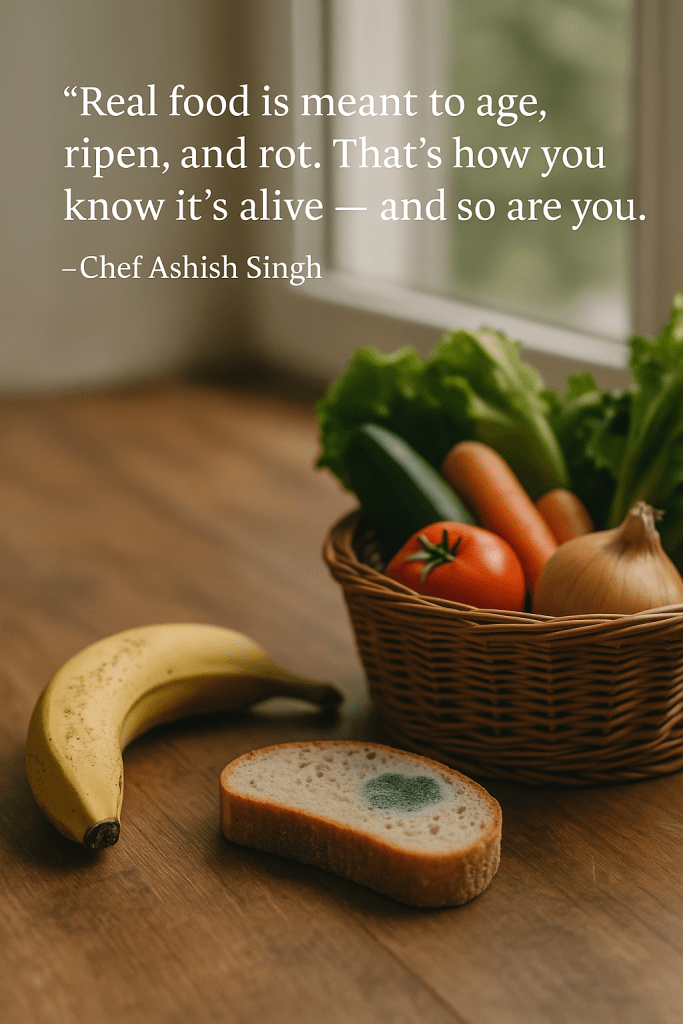
“Real food is meant to age, ripen, and rot. That’s how you know it’s alive — and so are you.”
— Chef Ashish Singh
Why Natural Decay Is Actually a Sign of Real, Healthy Food
The Truth About Spoilage
In today’s world, food is expected to look perfect, last forever, and stay shiny on store shelves for weeks. But here’s a little truth bomb — the faster your food goes bad, the more likely it is to be real, natural, and organic.
Why? Because it hasn’t been pumped full of chemicals to fight off nature.
So, Why Does Organic Food Spoil Faster?
Organic food is grown without synthetic fertilizers, pesticides, or preservatives. It’s untouched by the artificial techniques used to preserve appearance and delay decay. That makes it more prone to mold, bacteria, and natural breakdown — and that’s exactly what nature intended.
Examples That Say It All
1. Bananas:
Organic bananas brown faster because they ripen naturally. Regular ones are gassed and coated to stay yellow.
2. Bread:
An organic loaf will go moldy in 3–4 days. A supermarket bread? Might sit there for 2 weeks without a sign of life — because it’s packed with preservatives.
3. Milk:
Organic milk can turn into curd, sour cream, or buttermilk naturally. Commercial milk? When it goes bad, it stinks because it’s been stripped of its live bacteria and enzymes.
Is Spoiling Bad? Not at All.
It’s just a part of the food’s natural journey. Spoilage means your food is still alive in some sense. What’s really bad is food that resists rotting — because it’s been modified to act against nature.
The Price of Long-Lasting Foods
What keeps food fresh unnaturally often comes at a cost:
Preservatives can lead to allergies or gut issues.
Additives might disrupt your hormones.
Coloring agents can do more harm than good.
Long shelf life isn’t always worth it when it shortens your body’s vitality.
How to Make the Shift
Buy fresh and local.
Shop for smaller quantities more often.
Cook more at home.
Get comfortable with imperfect-looking food.
Learn how to preserve the natural way — with pickling, fermenting, or drying.
Don’t Fear the Spoil
Food that spoils is food that breathes. If your tomato gets soft or your bread molds faster, smile. You’ve chosen something honest, something that will nourish you the way food is meant to.
We live in a world where shelf life is king. Supermarkets stock shiny apples that look like they’ve been carved out of wax, loaves of bread that never grow mold, and packets of chips that could survive an apocalypse. But here’s a curious thing to consider: the faster your food spoils, the more natural and organic it usually is. And believe it or not, that’s not a bad thing at all — in fact, it’s a sign your food is more real than most things in the grocery store.
0 Comments