
“It may seem a trivial distinction, but choosing the
right time to sprinkle makes a real difference.”
If salting meat before cooking was just about adding flavor, the question of when to add it wouldn’t matter. However, salt does far more than enhance flavor. If you’ve poured salt over spilled red wine, you’ll know that salt has an incredible ability to soak up moisture, a quality known as “hygroscopy.” Rubbing salt on uncooked meat has a similar effect, drawing water out of the muscle, creating a layer of surface brine.
Enhancing texture
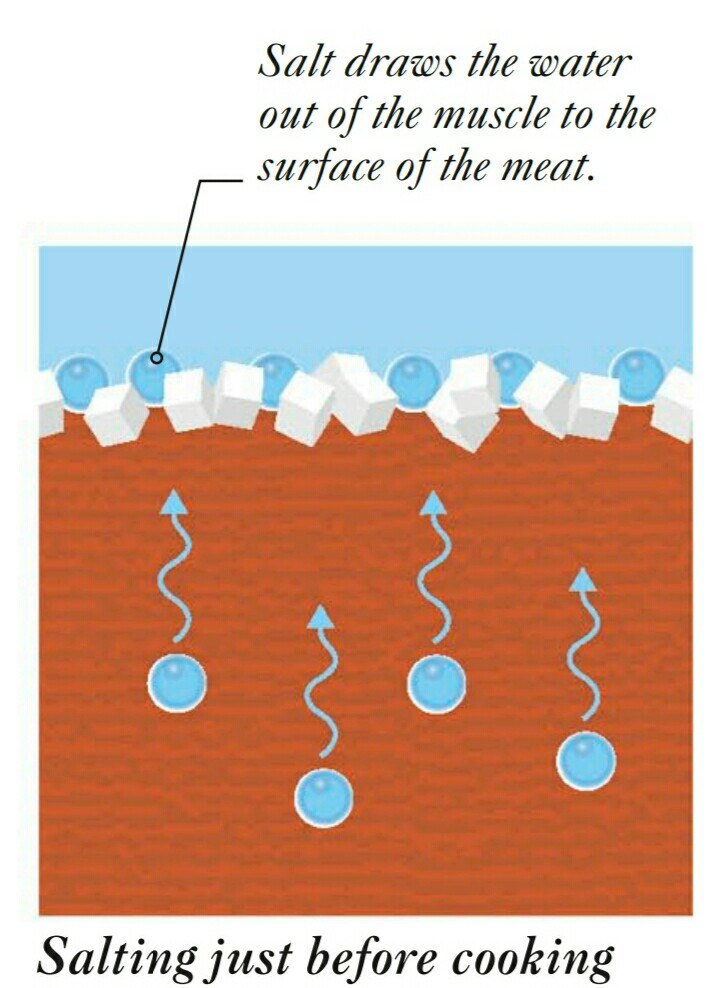
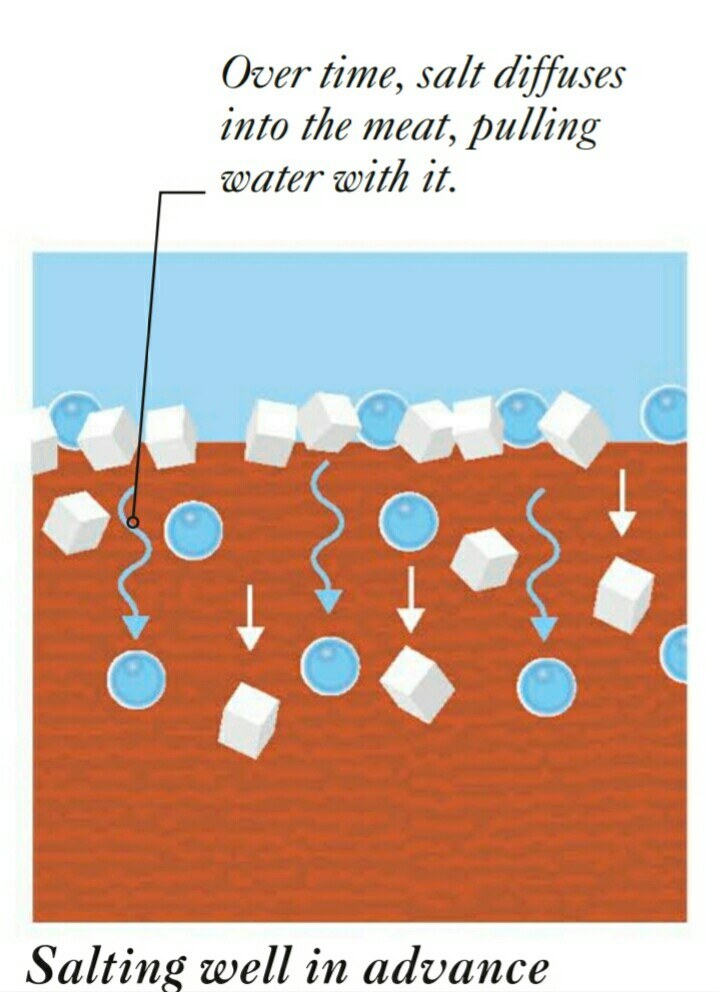
The diagrams, right, show the effects of salting meat just before
cooking and some time before. Salting meat just before cooking
creates a brine layer that can be dabbed off to dry the meat and help
it brown more quickly. Salting meat well in advance of cooking has added benefits. Left for longer, salt starts to tenderize meat by “denaturing”the surface proteins; after about 40 minutes, meat is noticeably softer.You can still dab the surface, too, before cooking to enhance browning.
The salting exception
While salt helps to tenderize whole cuts of meat, ground meat should not be per-salted. This softens the fine “grains” of the grind, making them stick together. A per-salted burger will become rubbery, and a cooked burger prepared in this way will actually bounce if dropped on the floor.
Salting just before cooking
Within a couple of minutes of salting, salt draws moisture out of the meat. This combines with the surface layer of salt to form a thin, sweat-like
covering of brine.
Salting well in advance
After about 15 minutes, salt and water start to draw back into the meat.The salty brine disrupts, or “denatures”,proteins, causing them to unwind, which softens and tenderised meat
MYTH BUSTER
Myth
MARINADES INFUSE MEAT WITH FLAVOR
Truth
It is physically impossible for marinades to penetrate far
into meat. Most flavor molecules are too large to squeeze into
the muscle tissue cells in meat, which are around 75 percent
water and packed tightly like a sodden sponge. Oil molecules,
which disperse most of the flavor molecules, are also unable
to enter muscle cells. This means that oil and flavor molecules
infuse no further than a few millimetres into the meat,
and instead pool on the surface.
0 Comments